There are no Conspiracy theories, there are only truth and lies.

Ionization and Plasma
Ultrafast heating and oxygen dissociation in atmospheric pressure air by nanosecond repetitively pulsed discharges
D L Rusterholtz, D A Lacoste, G D Stancu, D Z Pai and C O Laux
Published 31 October 2013 • © 2013 IOP Publishing Ltd
Journal of Physics D: Applied Physics, Volume 46, Number 46Citation D L Rusterholtz et al 2013 J. Phys. D: Appl. Phys. 46 464010DOI 10.1088/0022-3727/46/46/464010
Abstract
A detailed experimental investigation of the mechanism of ultrafast heating and oxygen dissociation produced by nanosecond repetitively pulsed discharges in atmospheric pressure air preheated at 1000 K is presented. The ultrafast mechanism creates excited electronic states of nitrogen, which then dissociate molecular oxygen through quenching reactions, with the remaining energy dissipated as heat. Optical and electrical diagnostic techniques have been applied to provide a self-consistent set of experimental data for a reference test-case with well-defined discharge and gas conditions. The pulses have a duration of 10 ns, an amplitude of 5.7 kV, a repetition frequency of 10 kHz and the pin-to-pin electrodes are separated by 4 mm. We present measurements of the gas temperature during and after the discharge using optical emission spectroscopy of the second positive system of nitrogen, spatially resolved profiles of the absolute densities of excited electronic states, determined using Abel-inverted spectra of the first and second positive systems of nitrogen, as well as the temporal evolution of the absolute densities of N2(A), N2(B), N2(C), electrons and atomic oxygen. These measurements are synchronized with electrical measurements of pulse current, voltage, and energy. The discharge is found to dissociate about 50% of molecular oxygen and to produce a temperature increase of about 900 K within 20 ns, corresponding to an ultrafast heating rate of about 5 × 10¹⁰ K s−1. Comparisons with numerical simulations show good agreement with the measurements and validate the ultrafast mechanism. About 35% of the electric energy deposited into the gas goes into O2 dissociation, and about 21% into gas heating. Finally, the dissociative quenching rates of N2(B) and N2(C) with O2 at 2200 K were measured and found to be 2.8(±0.6) × 10−10 cm3 s−1 and 5.8(±0.9) × 10−10 cm3 s−1, respectively. Combining these measurements with the literature values at 300 K, we propose a functional temperature dependence in the range 300–2200 K of 3.0 × 10⁻¹⁰(T/300)0.3 cm3 s−1 for the C state, and a constant value of 3.0 × 10⁻¹⁰ cm3 s−1 for the B state.
https://iopscience.iop.org/article/10.1088/0022-3727/46/46/464010
Why plasma bursts: ultrafast heating rate
How would creating an ion rich atmosphere help burn the city of Lahaina?
Fire needs three things: fuel, oxygen, and sufficient heat (the fire triangle).
Ionizing air means stripping electrons from molecules, creating ions or plasma. This does not add oxygen, fuel, or sustained heat in a useful way for ordinary combustion.
In normal conditions, ionized air recombines almost instantly, releasing negligible energy compared to what a flame needs.
Strong ionization usually requires very high voltages, radiation, or plasma arcs, which are dangerous and can just as easily disrupt or extinguish flames by blowing them out or breaking up the reaction zone.
Plasma-assisted combustion involves carefully controlled plasmas to help ignite very lean fuel mixtures or stabilize flames in engines. It’s about ignition efficiency.
From a physics standpoint, microwaves are very ineffective at heating air, and even if they did, that heating would not meaningfully accelerate combustion.
1. How microwaves interact with matter (physics). Microwaves heat materials primarily through dielectric loss. They couple to polar molecules (like liquid water) and cause rotational excitation. Energy is dissipated as heat when molecular motion is damped. Air is a very poor microwave absorber. Major components (N₂ ≈ 78%, O₂ ≈ 21%) are non-polar diatomic molecules. Their rotational transitions are weakly coupled at microwave frequencies. The result is that microwave absorption by air is extremely small.
2. Temperature vs ignition (combustion physics). Ignition requires a local temperature exceeding the activation energy for chemical reactions and sustained radical chain reactions (H·, O·, OH·). Heating the air slightly does not help much because combustion reactions occur at the fuel–oxygen interface, not in bulk air. Oxygen’s chemical reactivity is not enhanced by modest temperature increases. Reaction rates scale exponentially with temperature, but only near the reacting molecules, not distant gas. Unless the air temperature is raised by hundreds of degrees, the effect is negligible — and microwaves cannot do that to air efficiently.
3. Does microwave energy make things burn faster? Burn rate is typically limited by oxygen diffusion to the flame front, heat transfer back to the unburned fuel and chemical kinetics at the flame zone. Microwaves do not increase oxygen concentration, increase oxygen diffusivity nor change fundamental reaction pathways. Therefore, microwaves do not accelerate normal burning in open air.
4. Important distinction: heating fuel vs heating air. From a physics perspective microwaves can directly heat some fuels (especially polar or lossy materials). This can raise fuel temperature faster than external heating methods. That can lower ignition delay, but this is due to fuel heating, not air heating. Even then, once combustion is established, the flame temperature (~1500–2500 K) dwarfs any microwave contribution. Chemical energy release dominates completely.
5. Extreme cases (theoretical boundary). Only in very high-energy-density systems (e.g., plasma discharges, shock heating, ionized flows), air temperature rises enough to affect ignition. Microwaves are used indirectly to create plasmas, not to “warm air.” At that point, the mechanism is plasma chemistry, not microwave heating.
Physics conclusion: (1) Microwaves do not meaningfully heat air, (2) Heating air does not significantly promote ignition (3) Burn rate is not increased by microwaves in open combustion (4) Any observed effects come from direct heating of fuel, not altered air chemistry
What are plasma discharges?
Plasma discharges are phenomena where a gas becomes partially or fully ionized and can conduct electricity. Below is a physics-first explanation, starting from fundamentals and building up.
1. What “plasma” means (physics definition)
Plasma is often called the fourth state of matter:
A gas in which a significant fraction of atoms or molecules are ionized.
Contains free electrons, positive ions, and neutral particles.
Overall quasi-neutral (net charge ≈ 0 on large scales).
Strongly influenced by electromagnetic fields.
Key parameter:
Degree of ionization = (number of ions) / (total particles)
This can range from tiny (10⁻⁶) to nearly 1.
2. What a “discharge” is
A plasma discharge is plasma created and sustained by an electric field applied to a gas.
Mechanism:
A strong electric field accelerates free electrons.
Electrons collide with neutral molecules.
Collisions cause ionization and excitation.
New electrons are created → avalanche process.
The gas becomes electrically conductive.
This is fundamentally different from simply heating a gas.
3. Energy partition (important physics point)
In many plasma discharges:
Electron temperature is very high (1–10 eV ≈ 10,000–100,000 K).
Ion and neutral temperature may remain near room temperature.
This is called a non-equilibrium plasma. The plasma can drive chemistry without heating the bulk gas much. This is why plasma effects are not the same as thermal heating.
4. Types of plasma discharges (physics classification)
A. Glow discharge
Low pressure or controlled conditions
Uniform light emission
Used in neon signs, plasma research
Non-thermal
B. Arc discharge
High current, low voltage
Gas becomes very hot (thermal plasma)
Examples: lightning, welding arcs
Gas temperature can reach thousands of kelvin
C. Corona discharge
Localized ionization near sharp electrodes
Occurs at atmospheric pressure
Non-uniform, filamentary
D. Microwave discharge
Plasma sustained by microwave electric fields
Used in plasma processing and fusion research
Often non-thermal
5. Plasma discharges vs flames (key distinction)
A flame is chemistry-driven; a plasma discharge is field-driven.
6. Why plasma discharges matter in combustion physics
From a theoretical standpoint:
Plasmas can generate radicals (O·, H·, OH·) directly.
These radicals bypass activation energy barriers.
This can reduce ignition delay without heating the gas.
This is why plasma-assisted ignition works even when thermal heating doesn’t.
7. Governing physics (compact)
Plasma behavior is governed by:
Maxwell’s equations (fields)
Boltzmann equation (particle distributions)
Collisional cross-sections
Debye length (charge shielding)
Plasma frequency
A key scale:
λD=ε0kTenee2λD=nee2ε0kTe
If the system size ≫ Debye length, it behaves as plasma.
Core takeaway
A plasma discharge is an electrically sustained ionized gas.
It is not “hot air” in the usual sense.
It can drive chemistry via energetic electrons, not bulk heating.
This makes plasma fundamentally different from flames or microwave heating.
so how do you produce plasma discharges
ChatGPT said:
I’ll keep this purely conceptual and physics-level, not procedural.
How plasma discharges are produced (physics view)
A plasma discharge forms when energy input to a gas creates enough free electrons that ionization becomes self-sustaining. The core idea is always the same:
Electrons gain energy from an electromagnetic field faster than they lose it in collisions.
Once that condition is met, ionization cascades occur.
1. The fundamental requirement: electron acceleration
Neutral gases already contain a tiny background population of free electrons (from cosmic rays, radioactivity, thermal effects).
An applied electric or electromagnetic field:
Accelerates these electrons
Gives them kinetic energy between collisions
Enables impact ionization when energy exceeds ionization thresholds
This is the non-thermal route to plasma formation.
2. Ionization cascade (avalanche physics)
Once energetic electrons exist:
Electron collides with a neutral atom/molecule
If energy ≥ ionization energy:
e−+A→2e−+A+e−+A→2e−+A+
Electron population grows exponentially
Gas becomes conductive
Plasma discharge forms
This transition is often called electrical breakdown.
3. Energy delivery mechanisms (conceptual categories)
A. Static or slowly varying electric fields
Field energy accelerates electrons directly
Leads to DC or low-frequency discharges
Dominated by drift motion and collisions
B. Oscillating electric fields (RF / microwave)
Electrons oscillate rather than drift
Energy gained depends on phase relation between field and collisions
Can sustain plasmas without electrodes
C. Extremely strong localized fields
Field strength exceeds atomic binding forces locally
Can cause field ionization
No heating required initially
4. Thermal vs non-thermal plasma formation
Thermal plasma
Gas is heated until collisions ionize atoms
Ion and electron temperatures are similar
Requires very high energy density
Non-thermal (discharge) plasma
Electrons are energetic
Neutrals remain comparatively cool
Chemistry driven by electrons, not heat
Most plasma discharges fall into this second category.
5. Why pressure matters (important physics)
Pressure controls mean free path:
Low pressure → electrons travel far → gain more energy
High pressure → frequent collisions → harder to ionize thermally
Breakdown behavior depends on:
Gas species
Pressure
Field geometry
Field frequency
This relationship is summarized by Paschen-type scaling laws, not simple thresholds.
6. Plasma maintenance vs creation
Creating plasma is harder than maintaining it:
Initial breakdown requires higher energy
Once ionized, plasma conductivity:
Enhances field coupling
Reduces required sustaining energy
This is why discharges often show hysteresis.
7. Key physics quantities controlling discharge formation
Ionization cross-section
Electron energy distribution function (EEDF)
Mean free path
Electric field strength
Collision frequency
Recombination rates
Plasma exists when:
ionization rate>recombination rateionization rate>recombination rate
Conceptual summary
Plasma discharges are produced when:
A gas is subjected to strong electromagnetic fields
Free electrons gain enough energy between collisions
Ionization cascades overwhelm recombination
The gas becomes electrically conductive and field-responsive
No combustion, no oxygen chemistry required — just fields, electrons, and collisions.
Atmospheric plasma is defined as a type of plasma generated from electrical discharges in gases at atmospheric pressure, characterized by interactions involving charged particles such as electrons and ions, which can achieve high energies while the gas remains at low temperatures, resulting in nonequilibrium.
In high-voltage systems, ionizers, and plasma devices, ionized air is a recognized ignition and fire-risk factor.
1. Why these systems increase fire risk
A. Reduced ignition threshold
Ionization produces Free electrons, excited oxygen and nitrogen species and localized free radicals. These reduce the minimum ignition energy (MIE) of nearby flammable gases, vapors, dusts. Materials that would not normally ignite can do so near ionized regions.
B. Electrical discharge as the primary hazard
The discharge itself, not the ionized air, is the dominant ignition source is corona discharge, spark gaps, arc faults, dielectric breakdown, ionized air lowers breakdown voltage, making unintended discharges more likely and more mobile.
C. Ozone and reactive oxygen species
Ionizers and plasma devices often generate Ozone (O₃), atomic oxygen, nitrogen oxides (NOₓ). These are strong oxidizers that accelerate degradation of polymers and insulation, increase flammability of surfaces over time, and promote smoldering or delayed ignition.
2. Device-specific considerations
The high-voltage power equipment risks are arc tracking along contaminated or humid surfaces, partial discharge in insulation, ionized air extending arc length.
Plasma devices
Extremely high local temperatures
Highly reactive plasma chemistry
Direct ignition of fuels or substrates
Mitigations
Inert gas plasmas (argon, nitrogen) when possible
Interlocked enclosures
Exhaust and gas monitoring
Strict control of surrounding materials
3. Hazardous location implications
In explosive or flammable environments:
Ionized air dramatically increases ignition probability
Even low-energy discharges can trigger explosions
Accordingly:
Most ionizers and plasma devices are prohibited in ATEX / NEC Class I & II areas
Only specially certified intrinsically safe or explosion-proof equipment may be used
4. Summary for safety and design
Ionized air itself is not fuel, but in high-voltage contexts it:
Lowers ignition energy
Enables unintended electrical discharge
Produces aggressive oxidizers
Extends arc paths
As a result, ionization is treated in safety engineering as an ignition facilitator, not a benign side effect.
Bottom line
In high-voltage, ionizer, and plasma systems, ionized air increases fire and explosion risk.
High-powered microwaves and high-powered lasers can create ions, but only under specific physical conditions, and the mechanisms differ.
1. High-Powered Lasers are a standard tool for ionization They create ions and plasmas when tightly focused. Laser ionization occurs when the electric field of the light is strong enough to remove electrons from atoms or molecules:
Multiphoton ionization
Multiple photons are absorbed simultaneously to overcome the ionization energy.Tunnel ionization
Extremely strong fields distort the atomic potential, allowing electrons to “tunnel” out.Optical field ionization / plasma formation
At very high intensities, a cascade occurs, creating a plasma (ions + free electrons).
Typical thresholds
Ionization generally requires very high intensities (on the order of
1012–1014 W/cm210^{12}–10^{14}\ \text{W/cm}^21012–1014 W/cm2 and above, depending on the gas).Common in Fusion research, Particle acceleration and Atmospheric filamentation. Atmospheric filmentation is a physics phenomenon where an ultra-intense, ultrashort laser pulse (like from a femtosecond laser) self-focuses in the air, creating a narrow, bright thread of light (a filament) that travels much farther than normal, overcoming diffraction by balancing self-focusing (Kerr effect) and spreading. This process creates a plasma channel, enabling applications like long-distance remote sensing, pollution detection (Laser-Induced Breakdown Spectroscopy), weather modification (lightning control), and generating unique light sources for atmospheric studies.
2. High-Powered Microwaves can create ions, but not easily and not directly in most cases. Microwaves are different because microwave photons have very low energy (millielectronvolts). A single microwave photon cannot ionize an atom or molecule. Microwaves can create ions only when their electric fields accelerate free electrons, which then ionize atoms via collisions:
Seed electrons must already be present (from cosmic rays, background radiation, or field emission).
Strong microwave electric fields accelerate these electrons.
Electron–neutral collisions cause impact ionization.
An avalanche forms, producing a plasma.
Where this occurs
High-power microwave tubes
Microwave plasma sources
Magnetrons and gyrotrons
Atmospheric breakdown at extremely high field strengths
Thresholds
Requires very high electric field strength, often near or exceeding air breakdown (~3 MV/m).
Much less efficient than laser ionization.
Bottom line: Microwaves can create ions indirectly by sustaining or amplifying plasmas, but they are poor primary ionizers.
3. Key Comparison
AspectHigh-Power LasersHigh-Power MicrowavesPhoton energyHighVery lowDirect ionizationYesNoPlasma creationEfficientConditionalTypical usePrecision ionizationPlasma maintenanceRequires seed electronsNoYes
4. Practical Summary
Lasers: Direct, efficient ionization when sufficiently intense.
Microwaves: Indirect ionization via electron acceleration and collisions.
Both can produce ions and plasmas, but via fundamentally different physics.
If you want, I can go deeper into:
Atmospheric effects
Weapon-system implications (HPM vs laser)
Laboratory plasma sources
Breakdown thresholds in different gases
Ionization cross-sections and field strengths
What equipment is used to create plasma bursts
ChatGPT said:
“Plasma bursts” usually means short, pulsed releases of ionized gas. Haigh-voltage power supplies
Provide the energy needed to ionize gas
Often pulsed (microseconds to milliseconds)
Examples:
Marx generators
Capacitor banks
Pulsed DC or RF power supplies
2. Electrodes
Apply the electric field that creates the plasma
Common configurations:
Needle–plate
Coaxial electrodes
Parallel plates
The spacing and shape control burst intensity and shape
3. Capacitors & pulse-forming networks
Store energy and release it suddenly to create a “burst”
Control:
Pulse duration
Peak current
Repetition rate
4. Gas source or controlled atmosphere
Plasma is formed from a gas such as:
Argon
Helium
Nitrogen
Air
May be in:
Open air
Sealed chamber
Vacuum chamber (low-pressure plasma)
5. Switching devices
Trigger the burst precisely
Examples:
Spark gaps
Thyratrons
Solid-state switches (IGBTs, MOSFETs)
Specialized plasma-burst systems
6. Plasma guns / plasma injectors
Used in fusion research and space propulsion
Fire high-velocity plasma pulses using electromagnetic acceleration
7. Laser-induced plasma systems
Use high-power pulsed lasers
Laser instantly ionizes air or a surface
Used in:
Spectroscopy (LIBS)
Material analysis
Research physics
8. Dielectric Barrier Discharge (DBD) devices
Produce controlled plasma bursts at atmospheric pressure
Used in:
Surface treatment
Ozone generation
Medical plasma research
Important safety note
Creating plasma bursts involves:
Lethal voltages
Intense UV radiation
Electromagnetic interference
Fire and explosion risk
This equipment is used only in labs or industrial systems with proper shielding and controls.
If you’re asking in a specific context (physics research, industrial plasma, propulsion, or sci-fi realism), I can tailor the explanation further.
You said:
propulsion
ChatGPT said:
For propulsion, “plasma bursts” refer to short, controlled pulses of plasma expelled to generate thrust. These are real systems used (or researched) mainly in spacecraft propulsion. Below is a high-level, non-instructional overview of the main propulsion technologies and the equipment they use.
Plasma-burst propulsion systems
1. Pulsed Plasma Thrusters (PPTs)
Most common “plasma burst” propulsion
How it works (conceptually):
A solid propellant (often Teflon) is briefly vaporized
An electric discharge turns it into plasma
Electromagnetic forces accelerate the plasma outward in a pulse
Key equipment:
Capacitor bank (stores energy)
High-voltage discharge circuit
Electrodes
Solid propellant bar
Power conditioning unit
Used for:
Small satellites
Attitude control and station keeping
Pros / cons:
Very reliable, simple
Low thrust, but high efficiency
2. Magnetoplasmadynamic (MPD) Thrusters
High-power plasma pulse acceleration
Core idea:
Plasma is accelerated by the Lorentz force (current + magnetic field)
Key equipment:
High-current power supply
Anode and cathode
Magnetic field coils
Gas feed system (argon, lithium, hydrogen)
Used for:
Experimental deep-space propulsion
Requires nuclear or very large solar power
3. Plasma Guns / Coaxial Plasma Accelerators
True “plasma firing” devices
How they work:
Plasma is formed between coaxial electrodes
A strong current pulse ejects the plasma at high velocity
Key equipment:
Pulsed power supply
Coaxial electrodes
Gas injection system
Magnetic confinement fields
Used for:
Fusion research
Experimental propulsion concepts
Lab testing (not operational spacecraft yet)
4. VASIMR (Variable Specific Impulse Magnetoplasma Rocket)
Continuous or quasi-pulsed plasma flow
Key equipment:
RF plasma generator
Superconducting magnetic nozzles
High-power electrical source
Cryogenic systems
Note:
Plasma isn’t expelled in sharp bursts, but can be modulated
Extremely high efficiency
Still experimental
5. Laser-Induced Plasma Propulsion
External energy creates plasma bursts
How it works:
A pulsed laser creates plasma on a surface or in air
Plasma expansion produces thrust
Key equipment:
High-power pulsed laser
Optics and focusing systems
Target or propellant surface
Used for:
Micro-propulsion research
Conceptual launch assist systems
What all plasma propulsion systems share
No combustion
Electrical energy → plasma → momentum
Require:
High-voltage or high-current systems
Precise timing control
Thermal and electromagnetic shielding
Reality check
Plasma propulsion:
❌ Does not produce explosive thrust
❌ Does not work well in atmosphere
✅ Is extremely efficient in vacuum
✅ Ideal for long-duration space missions
If you want, I can:
Compare plasma propulsion vs chemical rockets
Explain which systems could work for sci-fi realism
Focus on smallsat vs deep-space applications
You said:
industrial plasma
ChatGPT said:
In industrial settings, plasma is used in controlled, engineered systems for manufacturing, materials processing, and environmental applications—not propulsion or weapons. Below is a clear, high-level overview of the equipment used to generate and control industrial plasma, including pulsed (“burst”) plasma where relevant.
Core equipment in industrial plasma systems
1. Power supplies
The heart of any plasma system.
Types used:
DC power supplies – steady plasmas (welding, cutting)
Pulsed DC – plasma bursts for better control and reduced heating
RF (radio frequency) – common in semiconductor manufacturing
Microwave – high-density plasmas
Functions:
Ionize gas
Control plasma density and stability
Enable precise on/off pulsing
2. Electrodes
Create the electric field that sustains the plasma.
Common designs:
Parallel plate
Coaxial
Needle or point electrodes
Rotating or water-cooled electrodes (high power)
Materials:
Copper
Tungsten
Graphite
Stainless steel
3. Process gas delivery system
Plasma is created from gases such as:
Argon
Nitrogen
Oxygen
Hydrogen
CF₄, SF₆ (etching applications)
Includes:
Gas cylinders
Mass flow controllers
Valves and regulators
4. Plasma chamber or torch
Where plasma is formed and applied.
Types:
Vacuum chambers (low-pressure plasma)
Atmospheric-pressure systems
Plasma torches (open-air, high temperature)
Made from:
Stainless steel
Quartz or ceramic liners
Water-cooled housings
5. Vacuum systems (when applicable)
Used in semiconductor and coating industries.
Components:
Roughing pumps
Turbo-molecular pumps
Pressure sensors
Throttle valves
6. Pulse control & switching electronics
Enable plasma bursts instead of continuous discharge.
Includes:
Capacitor banks
Pulse-forming networks
Solid-state switches
Timing controllers (PLC or computer-controlled)
Benefits of pulsed plasma:
Less thermal damage
Better surface chemistry control
Higher process uniformity
Specialized industrial plasma systems
7. Dielectric Barrier Discharge (DBD) systems
Use insulating layers to limit current
Naturally operate in short plasma bursts
Used for:
Surface activation
Ozone generation
Sterilization
8. Inductively Coupled Plasma (ICP) systems
Plasma generated by magnetic fields (no electrodes inside chamber)
Very clean, stable plasma
Used in:
Semiconductor etching
Analytical instruments (ICP-MS, ICP-OES)
9. Plasma arc systems
Extremely hot, high-power plasma
Used for:
Plasma cutting
Welding
Waste destruction
10. Cold / non-thermal plasma devices
Plasma is energetic, but bulk gas stays near room temperature
Used for:
Medical device sterilization
Food packaging
Polymer surface treatment
Common industrial applications
Semiconductor fabrication (etching, deposition)
Metal cutting and welding
Surface cleaning and activation
Thin-film coatings
Sterilization and decontamination
Environmental remediation
Safety considerations (industrial context)
Industrial plasma systems require:
Shielding from UV and EM radiation
High-voltage safety interlocks
Gas handling controls
Thermal management and cooling
Regulatory compliance (ISO, SEMI, OSHA)
If you want, I can narrow this down to:
Semiconductor fabs
Metal fabrication
Atmospheric vs vacuum plasma
Cold plasma vs thermal plasma
Why pulsed plasma is preferred in industry
Just tell me the focus.
You said:
Environmental remediation
ChatGPT said:
In environmental remediation, industrial plasma systems are used to destroy pollutants, sterilize contaminants, and convert hazardous compounds into safer by-products. These are controlled, non-combustion technologies used in water treatment, air pollution control, and waste processing.
Below is a practical, high-level overview of the plasma equipment and system types used specifically for environmental remediation.
How plasma helps environmental remediation
Plasma produces:
Energetic electrons
Reactive species (•OH, O₃, O, NOₓ)
UV radiation
These break down:
Persistent organic pollutants (PFAS, pesticides)
VOCs and odors
Pathogens (bacteria, viruses, spores)
Toxic gases and liquids
Core plasma equipment used
1. Non-thermal (cold) plasma generators
Most common for environmental use.
Why cold plasma?
High chemical reactivity
Minimal heat damage
Works at atmospheric pressure
Equipment includes:
Pulsed high-voltage power supply
Dielectric Barrier Discharge (DBD) or corona electrodes
Gas flow system (air, oxygen, argon)
Control electronics
Used for:
Water purification
Air treatment
Surface decontamination
2. Dielectric Barrier Discharge (DBD) reactors
A workhorse technology.
Characteristics:
Naturally produces short plasma bursts
Prevents arc formation
Highly scalable
Common applications:
Ozone generation
VOC destruction
Pathogen inactivation
3. Plasma reactors (treatment chambers)
Where contaminants are exposed to plasma.
Types:
Flow-through reactors (air or water)
Bubble plasma reactors (plasma inside liquid)
Surface discharge reactors
Materials:
Quartz
Ceramics
Stainless steel with dielectric coatings
4. High-voltage pulsed power systems
Enable precise plasma control.
Components:
Capacitor banks
Solid-state switches
Pulse controllers
Benefits:
Energy efficiency
Tunable chemistry
Reduced electrode erosion
5. Gas handling & injection systems
Plasma chemistry depends heavily on gas composition.
Includes:
Air or oxygen injection
Controlled humidity
Optional noble gases (argon)
Specialized plasma remediation systems
6. Plasma water treatment systems
Used for:
PFAS destruction
Pharmaceutical residue removal
Microbial sterilization
Methods:
Plasma over liquid
Plasma in bubbles
Plasma-activated water (PAW)
7. Plasma air pollution control
Targets:
VOCs
NOₓ
SOₓ
Odors
Often combined with:
Catalysts (plasma-catalysis)
Filters or scrubbers
8. Thermal plasma systems (high power)
Used for extreme waste.
Examples:
Plasma gasification
Hazardous waste destruction
Medical and chemical waste
Equipment:
Plasma torches
DC arc power supplies
Refractory-lined reactors
Slag handling systems
Advantages over traditional methods
✅ Destroys pollutants instead of transferring them
✅ Effective against “forever chemicals”
✅ Minimal chemical additives
✅ Fast reaction times
✅ Can be retrofitted into existing systems
Limitations and challenges
⚠ High electrical power demand
⚠ Electrode wear
⚠ By-product control (e.g., NOₓ, ozone)
⚠ Cost at large scale
Safety & compliance
Industrial plasma remediation systems include:
High-voltage interlocks
Ozone and NOₓ monitoring
EMI shielding
Automated shutdown systems
Environmental regulatory compliance
Typical real-world uses today
Drinking water treatment pilots
Wastewater polishing
Industrial exhaust cleanup
Hospital and lab waste sterilization
Soil and groundwater remediation research
If you want, I can go deeper into:
PFAS destruction
Water vs air plasma systems
Cold plasma vs plasma gasification
Energy efficiency and scaling
Commercial vs research-stage systems
Just tell me the direction.
You said:
Is plasma bursts used outside in the environment for any reason
ChatGPT said:
Yes — plasma bursts are used outdoors, but only in very controlled, practical ways, and as free-floating or weaponized effects. Their outdoor use is limited by safety, power needs, and environmental control.
Here’s where and why plasma bursts are used outside:
1. Air pollution & odor control (outdoor / open-air systems)
Most common real-world outdoor use
Non-thermal plasma (DBD or corona discharge) is used in:
Industrial exhaust stacks
Wastewater treatment plants
Landfills
Plasma bursts break down:
VOCs
Odors
NOₓ and SOₓ
Often combined with catalysts or scrubbers
➡ Plasma is generated inside reactors, but the system operates outdoors.
2. Ozone generation for environmental treatment
Outdoor ozone systems use pulsed plasma discharges
Applications:
Water disinfection
Algae control
Industrial sanitation
Ozone is produced on-site because it cannot be stored
⚠ Ozone is tightly regulated due to health risks.
3. Agriculture & environmental biology
Growing area of use
Plasma bursts are used outdoors or near-field for:
Seed treatment (improves germination)
Plant pathogen control
Plasma-activated water for irrigation
These systems:
Use cold plasma
Operate at atmospheric pressure
Produce short, low-energy plasma bursts
4. Lightning & surge protection research
Plasma discharges are used outdoors to:
Study lightning behavior
Trigger controlled lightning (with rockets or lasers)
Improve lightning rod design
This is research and infrastructure protection, not routine deployment.
5. Aerodynamics & wind control (experimental)
Plasma actuators generate rapid micro-bursts of plasma on surfaces
Used to:
Reduce drag
Control airflow
Tested on:
Aircraft wings
Wind turbines
UAVs
Mostly experimental, sometimes outdoor testing.
6. Waste treatment & remediation sites
Plasma systems are deployed on-site for:
Hazardous soil treatment
Chemical neutralization
Plasma occurs inside shielded reactors, not open air
What plasma bursts are not used for outdoors
❌ Free-floating plasma “blasts”
❌ Long-range energy projection
❌ Atmospheric propulsion
❌ Environmental manipulation at large scale
Plasma dissipates extremely fast in open air and becomes inefficient and dangerous if uncontrolled.
Natural plasma bursts (for context)
Lightning
Corona discharge on power lines
St. Elmo’s fire
These inspire technology but are not deliberately replicated at scale outdoors. Plasma bursts are used outdoors.
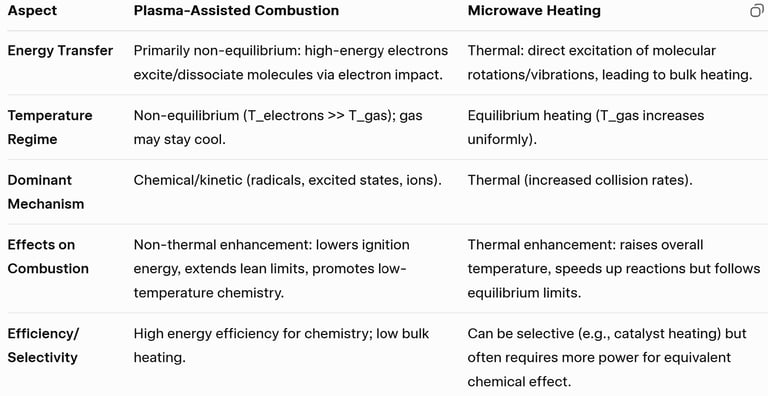
How does plasma-assisted combustion differs fundamentally from microwave heating?
Plasma-assisted combustion and microwave heating are distinct approaches to enhancing combustion processes, with fundamental differences in their mechanisms, energy transfer, and effects on the reacting mixture.
Plasma-Assisted Combustion (PAC)
Plasma-assisted combustion typically involves generating non-equilibrium (non-thermal) plasma using high-voltage electrical discharges (e.g., nanosecond pulsed discharges, dielectric barrier discharges, corona, or gliding arcs). In non-equilibrium plasma, electrons reach very high temperatures (thousands of K), while the bulk gas remains near room temperature or only modestly heated. The primary effects include:
Production of reactive species (radicals like O, OH, H; excited molecules; ions).
Dissociation and ionization of fuel/oxidizer molecules.
Kinetic enhancement of combustion chemistry (e.g., faster chain-branching reactions, reduced ignition delay, wider flammability limits).
Some thermal heating from relaxation of excited states, but the dominant benefit is often non-thermal (chemical activation).
This enables leaner combustion, improved flame stability, and reduced emissions without significant bulk gas heating.
Microwave Heating
Microwave heating primarily refers to thermal (volumetric) heating, where microwaves (typically ~2.45 GHz) excite polar molecules (e.g., water, some fuels) or induce dielectric losses, leading to uniform bulk heating. In combustion contexts, this is often used for:
Preheating reactants or catalysts.
Enhancing reaction rates through equilibrium temperature increase.
Selective heating of materials (e.g., catalysts).
Microwave heating is thermal in nature — it increases translational and rotational temperatures uniformly, accelerating reactions via Arrhenius kinetics.
Key Fundamental Differences
Microwave Plasma: A Hybrid Case
Note that microwave plasma (generated by microwaves at low pressure or in specific setups) is a form of non-equilibrium plasma (similar to PAC), not pure heating. It produces energetic electrons, radicals, and non-thermal effects, often used for ignition or flame enhancement. This differs from standard microwave heating, which avoids plasma formation to focus on thermal effects. In combustion literature, "microwave-assisted" often implies plasma when it involves discharges, but pure microwave heating is thermal.
In summary, plasma-assisted combustion fundamentally differs from microwave heating by relying on non-thermal, electron-driven chemistry rather than bulk thermal energy. This allows PAC to achieve enhancements (e.g., ultra-lean combustion) that pure thermal heating cannot match without excessive temperatures.
Plasma bursts from aircraft can be natural (
St. Elmo's Fire in storms), technology-driven (plasma actuators for flight control, propulsion), or even linked to space phenomena like solar flares disrupting systems, with recent research exploring plasma for quieter, efficient flight and even advanced military uses. These glowing discharges, ionized air, can appear around sharp points on planes or helicopters during storms, but also as engineered systems to manipulate airflow or provide thrust, creating unusual visual effects.
Natural Phenomena (St. Elmo's Fire)
What it is: A luminous, glowing plasma that forms on pointed objects (masts, spires, aircraft) during thunderstorms due to intense electric fields ionizing air.
Appearance: A soft glow or flickering lights, often seen on wingtips or propellers.
Engineered/Technological Plasma
Plasma Actuators: High-voltage systems that ionize air to create localized plasma, controlling airflow over wings to reduce drag, prevent stalls, and improve lift, especially for drones.
Plasma Propulsion: Experimental systems using strong electromagnetic fields to ionize air, creating thrust without propellers, leading to silent, fuel-free flight.
Military Applications: Lasers can create plasma flares for decoys or defense, appearing as glowing UFO-like shapes.
Space-Related Incidents
Solar Flares: Bursts of solar radiation can interfere with aircraft electronics, causing system glitches or control issues, sometimes mistaken for plasma events.
Plasma Bubbles: Naturally occurring upper-atmosphere plasma irregularities that can disrupt radio signals, causing communication blackouts for aircraft.
How to Differentiate
Natural: Often tied to storms, seen as glow on extremities.
Engineered: May appear as controlled bursts or continuous streams, often near control surfaces or propulsion areas on drones/experimental craft.
Space-Induced: Typically system-wide glitches rather than localized plasma, but can cause sudden aircraft movements.
So, plasma bursts can come from natural electrical events, cutting-edge aerospace tech, or even solar interference, affecting anything from military jets to drones.
Laser-metal induced plasmas, more commonly referred to as laser-induced plasmas (or laser-produced plasmas) on metals, are high-temperature, partially ionized gases formed when a focused high-power laser pulse interacts with a metal surface.
Formation Process
A pulsed laser (often nanosecond or shorter duration, with intensity ≥10⁸ W/cm²) is focused onto the metal target. The laser energy is rapidly absorbed by free electrons in the metal, leading to:
Heating and melting of the surface.
Vaporization and ejection of material (ablation).
Ionization of the vapor, creating a plume of electrons, ions, neutral atoms, and sometimes clusters or nanoparticles.
This results in a hot (temperatures >10,000 K initially), dense plasma that expands away from the surface, often producing a shock wave.
Plasma weapons are a form of directed energy.
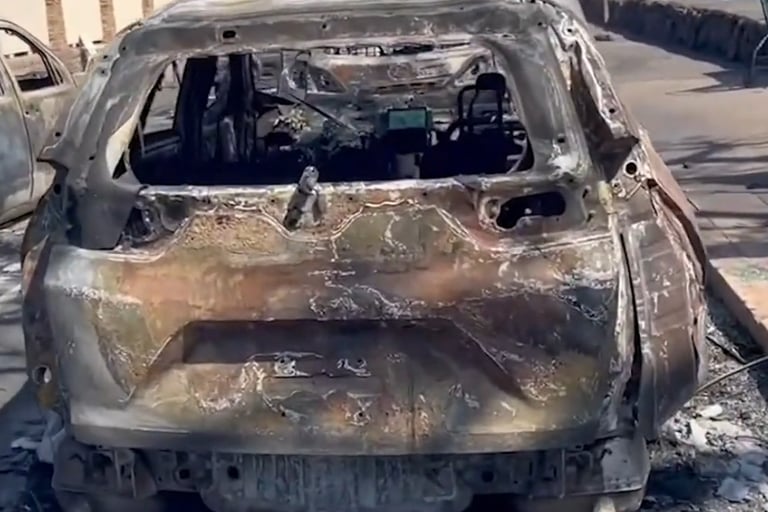
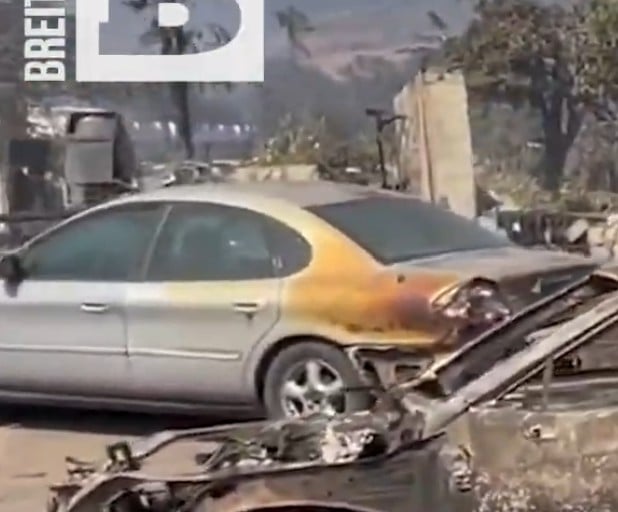
Plasma weapons fire a beam, bolt, or stream of plasma, which is an excited state of matter consisting of atomic electrons & nuclei and free electrons if ionized, or other particles if pinched. The atmosphere in Lahaina was prepared for plasma to occur easily. The hurricane Dora presented with the low pressure area and the coherent clouds with high pressure above with Maui in the middle created a very excited area between. It is interesting that there was also a hurricane offshore New York on that day in 2001 when the twin towers came down. One form of DEW is a particle beam weapon and it may have been used on 9-11to disappear the towers. The same things seen in Lahaina were also seen in New York, cars were melted to ash and buildings burned completely.
The Most Mysterious Weapon in the World: What is a Plasma Weapon?

You can make plasma from oxygen, and it's a common practice in industries for cleaning, etching, and surface treatment, created by adding energy (like radio waves or electricity) to oxygen gas in a low-pressure chamber, which strips electrons from the molecules, forming ionized oxygen plasma (a mix of ions, electrons, and neutral atoms). While pure oxygen plasma is white and can be harder to see than air plasma, it's highly effective for modifying surfaces, especially plastics and polymers, by oxidizing them. Apply high-frequency radio waves (RF) or electrical fields. The energy rips electrons from the oxygen molecules, creating ions and free electrons, which is the plasma state.
Join us in advocating against the misuse of technology.
contact@targetedhumans.org
© 2025. All rights reserved.


Targeted Humans Inc.