There are no Conspiracy theories, there are only truth and lies.
Internet of Things
Pairing a Wireless Body Area Network (WBAN) with occupant location technology creates systems for real-time, location-aware health and activity monitoring, enabling immediate response during emergencies and enhancing remote care in smart environments. This integration is a key component of the Internet of Things (IoT) in healthcare (IoMT).
How the Pairing Works
The integration typically involves a multi-tiered architecture:
WBAN (Tier 1): On-body or implantable sensors (e.g., heart rate, temperature, blood pressure monitors) form a short-range network, collecting physiological data from a person. Technologies like Bluetooth Low Energy (BLE), Zigbee, and the IEEE 802.15.6 standard are commonly used for this low-power communication.
Control Unit/Gateway (Tier 2): A personal device, such as a smartphone or a dedicated hub, collects the data from the WBAN sensors.
Occupant Location Technology (Tier 2/3): The control unit or specific nodes within the local infrastructure incorporate location technology to determine the person's precise location.
Outdoors: GPS modules are commonly used in the control units (hubs) to provide accurate location information for applications like pandemic surveillance or emergency response in outdoor areas.
Indoors/Smart Environments: Indoor positioning systems utilize various methods, including integration with Wi-Fi access points, Ultra-Wideband (UWB) devices, or even millimetre wave (mmWave) radar systems, to track occupants within a building with high accuracy.
Remote Server (Tier 3): The combined health and location data is transmitted via the internet (cellular, Wi-Fi, etc.) from the gateway to a remote medical server or cloud database for analysis, storage, and professional review.
Key Applications
Elderly Monitoring: Remote monitoring of elderly individuals in their homes, allowing caregivers and healthcare professionals to track not only vital signs but also daily activities, sleep patterns, and location within the residence, enabling timely intervention.
Emergency Response: In critical scenarios, location information can be crucial for locating a patient who needs immediate help, ensuring a rapid and precise emergency response.
"Virtual Wards": Patients can be monitored in the comfort of their homes instead of a hospital, with mobile medical teams dispatched when data (including location) indicates an issue.
Industrial Safety: Tracking the location and health status of workers in hazardous environments to ensure safety and enable quick location in case of an accident.
While promising, this integration presents challenges, primarily regarding data and location privacy. Strong encryption and meticulous security measures are vital to protect highly personal health and location data from unauthorized access. The energy consumption of location-aware nodes is also a significant consideration in resource-constrained WBAN systems.
The Internet of Things (IoT) is a vast network of physical objects—from smart home devices and wearables to industrial machinery—embedded with sensors, software, and connectivity to collect and exchange data over the internet, creating a digital layer that enables smarter, more automated interactions and insights for improved efficiency and convenience in homes, cities, and industries.
Things & Sensors: Everyday objects are equipped with sensors (like temperature, motion, or location) to gather data about their state or environment. Devices connect to the internet (or other networks) via Wi-Fi, Bluetooth, cellular, or other protocols. They send collected data to central systems or other devices, often using cloud platforms. The data is analyzed, triggering actions (like adjusting a thermostat) or providing insights (like predictive maintenance for a factory machine).
Smart Homes: Smart thermostats (Nest), speakers (Alexa), lighting, security cameras, and refrigerators.
Wearables: Smartwatches and fitness trackers monitoring health data.
Industry (IIoT): Sensors on factory machines for predictive maintenance, smart grids, and agricultural sensors.
Smart Cities: Connected traffic lights, smart meters, and environmental sensors.
Healthcare: Remote patient monitoring with connected heart monitors.
Benefits: Optimizes processes and resource usage (e.g., water management). Automates tasks and provides remote control. Generates valuable data for better decision-making. Enables predictive maintenance, preventing failures.
Security Considerations. Because IoT devices collect and transmit data, they can be vulnerable to security risks if not properly configured, potentially allowing unauthorized access or data theft.

They’re Watching You Through Wi-Fi… And You Have No Idea
Internet of Bodies
Life in the Grid
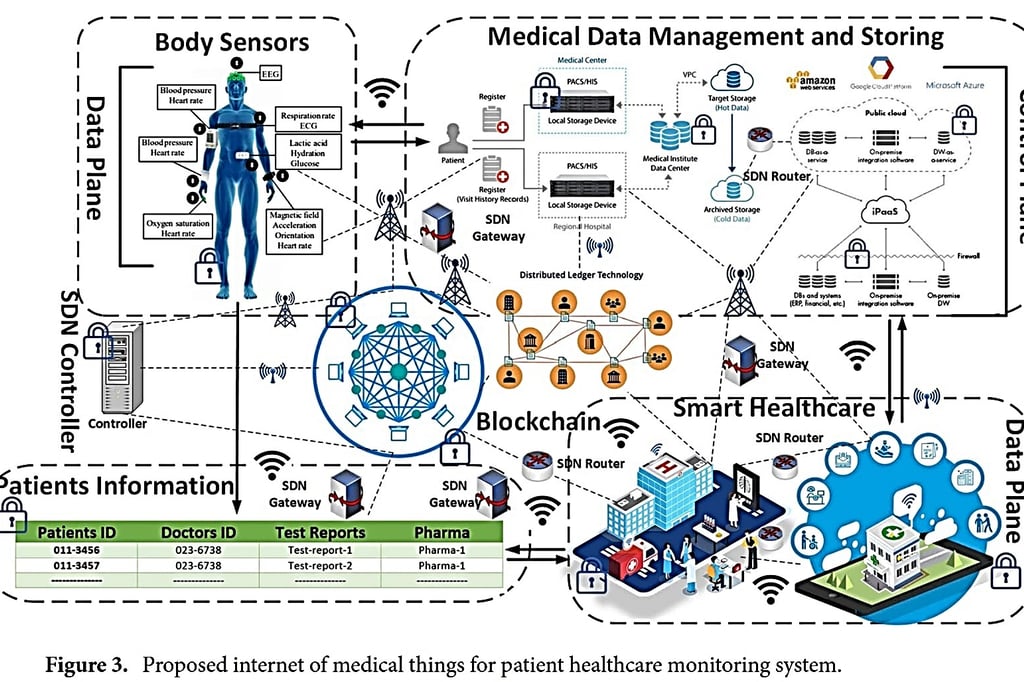
Internet of medical things and blockchain‑enabled patient‑centric agent through SDN for remote patient monitoring in 5G network
https://www.nature.com/articles/s41598-024-55662-w
Dataset description
The data collecting capability utilizes Internet of Things-enabled sensing devices to gather real-time tracking medical data from patients. Sensor technology advances in terms of data handling in biooptic sensors including EEG biotelemetry, electrocardiogram (ECG) sensor, blood pressure checking, heart rate monitoring, insulin monitoring, virus monitoring, and healthcare surveillance. It demonstrates how ubiquitous, on-demand access to a common pool of customizable computer environments may be implemented.
Internet of Medical Things
Potential of Internet of Medical Things (IoMT) applications in building a smart healthcare system: A systematic review
https://pmc.ncbi.nlm.nih.gov/articles/PMC8664731/
This structured systematic review intends to identify the pivotal role of IoMT applications in improving healthcare system and to analyze the status of research implementations demonstrating effectiveness of IoMT benefits to the patient and healthcare system along with a brief insight into the technologies supplementing IoMT and challenges faced in developing a smart healthcare system. The first section describes the different layers, their role and workflow in IoMT. The second section unveils the different technologies that integrate with IoMT to facilitate healthcare delivery in modern times. The third section describes applications of IoMT in Healthcare. The last section enumerates the challenges faced in wide-scale employment of IoMT and finally a crisp conclusion of the overall discussion is presented.
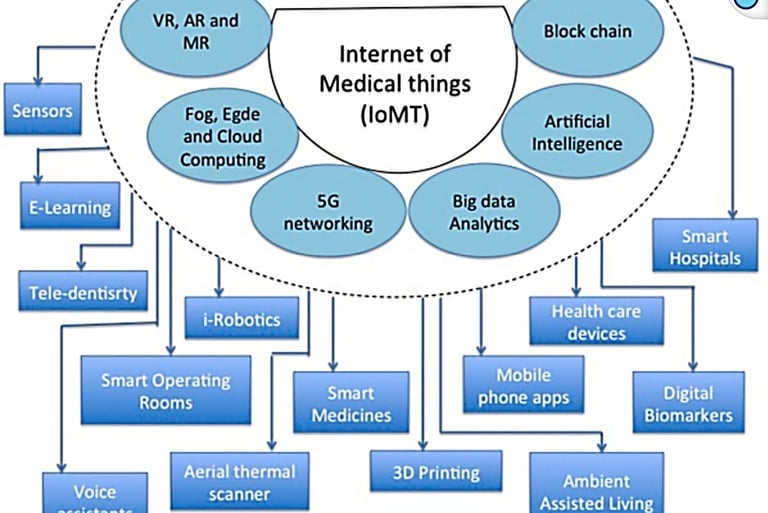
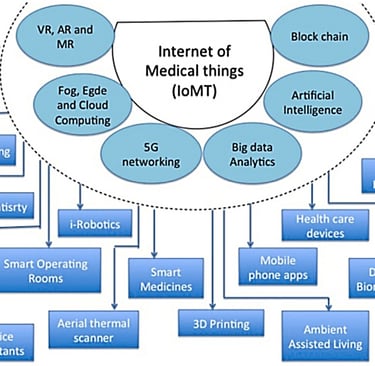
Internet of Medical Things: Remote Healthcare Systems and Applications is a book that explores how connected medical devices and sensors (IoMT) are transforming healthcare, particularly for remote and rural areas, by enabling real-time patient monitoring, virtual assistance, and improved diagnostics through technologies like AI, machine learning, and data science, while also addressing critical issues like security and data management. It serves as a reference for researchers, students, and professionals in engineering and healthcare, covering topics from wearable sensors and implantable devices to data compression and blockchain security.
Remote Patient Monitoring: Using wearables and other sensors for continuous, real-time tracking of vital signs and other health data
Telemedicine Integration: Combining IoMT with telemedicine for remote consultations and care delivery.
Enabling Technologies: Discusses AI, machine learning, data science, and blockchain for data analysis, security, and workflow management.
Applications: Covers post-surgery care, virtual home assistance, smart diagnosis, and specific use cases like breast cancer monitoring.
Challenges: Addresses security vulnerabilities, data privacy, and the need for efficient data compression and archiving.
Target audience: Researchers and students in biomedical, electronics, and communications engineering, practicing healthcare professionals, and academicians, scholars, and practitioners in data science, AI, and telemedicine.
Join us in advocating against the misuse of technology.
contact@targetedhumans.org
© 2025. All rights reserved.
Targeted Humans Inc.